Life after reversal surgery

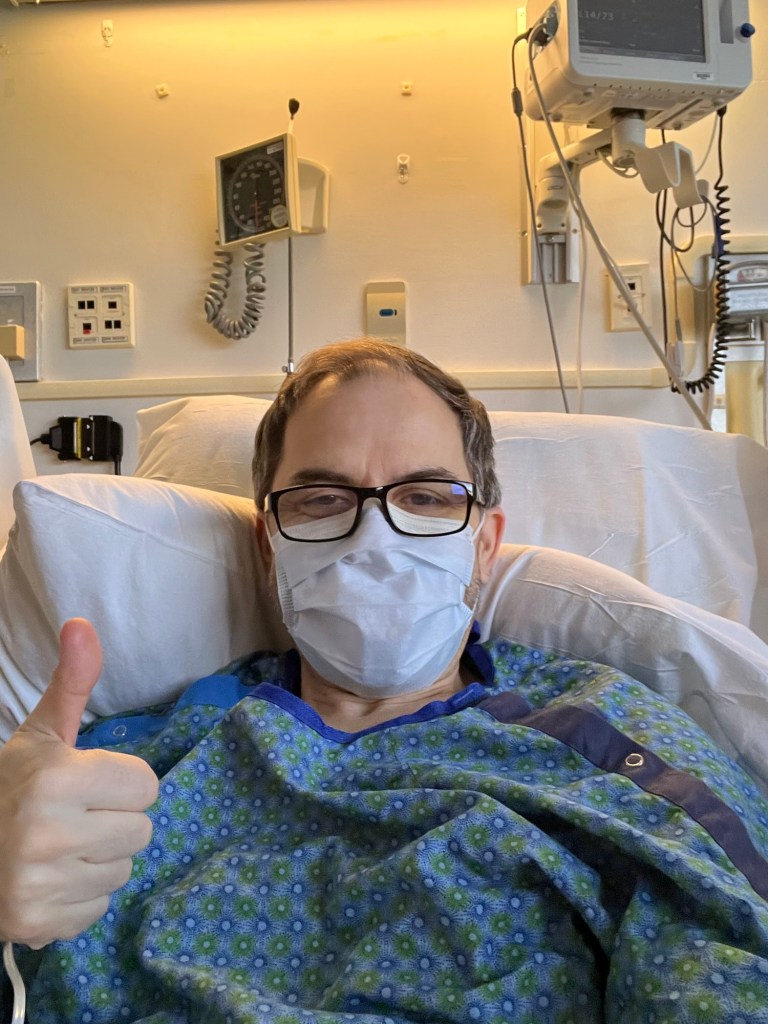
Fortunately, things have been much easier with my reversal surgery than my prior surgery, back in January. With my reversal, I was discharged from the hospital two days after the surgery took place. I’m back at work, as of yesterday. My energy levels are good; there were just a few days of fatigue. And my pain at the surgical site has improved; I was able to manage it with just Tylenol after I was discharged, and I haven’t had any Tylenol since yesterday morning.

An hour or so before the reversal surgery took place, back on Apr 18, a resident physician (who worked with my surgeon on the procedure), spoke with me briefly about what to expect with the surgery. “Did you give it a name?” she asked. After a few moments of confusion, I realized she was talking about my stoma. I told her no, I never named it (although I did observe this to be a thing that other folks do, noted in the ostomy subreddit and other places). She seemed to be ready to comfort me with any grief I had about the loss of the stoma through reversal surgery. Nope … I felt no sadness about the end of that phase. Yes, it was a pretty enlightening experience, having the ileostomy, but I am certainly ok to move on.

On the morning of my discharge from the hospital, that same resident came by and helped change my dressing over the wound site. The wound was “packed” (gauze was coiled inside the hole in my stomach) and I watched with somewhat horrified fascination as she pulled out that blood-soaked gauze, and applied new dressing. I’ve been doing this same routine on my own, every day since, along with a thorough cleaning of the area via a shower. The hole is already closing up — pretty fascinating to track its progress every day. When I first got out of the hospital, it looked like this surreal second belly button — not too far away from my actual belly button — and a bit wider. Just to clarify, this hole did not go all the way into my innards; the resident explained that it stopped at the layer of my abdominal fascia.

Other than those daily cleanings and dressing changes, the main challenge post-reversal has really been adjusting to having a functioning colon again — with a rectum that is now considerably smaller. I have read several stories of folks dealing with LARS after their reversal and I was prepared for something similar, myself. But things seem to be largely ok with me in the bathroom area, after an initial period of constipation (which I was able to address via Miralax). Bowel movements are certainly more frequent, with associated urgency, but I’m already seeing improvement with this as well, day after day.

I continue to derive tons of helpful information from the Colontown family of online forums; yes they have one specifically dedicated to all things reversal (“Reversal Roundabout.”) From there, I learned that a first order of business for many folks after their reversal is to restore their gut’s bacteria through probiotics. The challenge is that with a reversal surgery –as with the LAR surgery before it — you get stuck on a restrictive low-fiber diet, which excludes most of the effective dietary sources of probiotics. So what a lot of folks do, I learned, is drink kombucha, at least up until their dietary guidelines loosen up again. I had never actually tried kombucha before, but decided to give it a shot, starting around a week ago, and I quickly realized I love it! Tasty and refreshing!

A week from now, I have CT scans at Fred Hutch; assuming all is clear from those, I’ll finally be able to start saying I’m NED. Of course, you never know what the scans may reveal. I’ve been tracking a variety of stories in Colontown, and of course not everything is positive. Someone with a Stage 3 diagnosis who started chemo on the exact same day I did, last year, just got news that her cancer is metastasizing and she’s now stage 4. I’ve also read recent posts of stage 4 patients passing away. These are notably poignant when it’s the patient themselves sharing the news of their upcoming demise. That said, I do not have “scanxiety;” instead I’m aware of the spectrum of possibilities that may come out of any CT scan, and will take things one step at a time.
Another radio interview

I was interviewed for another radio spot recently, along with other CRC survivors in the greater Seattle area — here’s the link for this one (I’m at the beginning).

I also went in yesterday for a barium enema — this is the first of two diagnostic appointments that need to happen, before my ostomy reversal surgery scheduled for Apr 21. All seems ok, based on the real-time feedback they provided during the procedure, and the summary now available in mychart:

1. Status post low anterior resection with patent end-to-end anastomosis and no leak of contrast seen.

2. The remainder of the large bowel is normal in appearance.

For folks like myself with an ostomy, the barium enema procedure is easier in some ways — you don’t have to do any of the bowel prep that is normally required. They did ask me to bring in supplies for an ostomy bag change, as there is a possibility of the contrast flooding the bag and causing it to burst. Fortunately that did not happen (although some contrast eventually made its way into the bag, later that day).

I did get a helpful piece of advice from the ostomy facebook group that I follow — to bring an adult diaper to this appointment, and put it on immediately after. This is because that contrast solution — which is all inserted through the rectum — gradually seeps out, for quite a long time. I was surprised to find that it was still coming out, well into the next day. Yes, fun fun. But glad the results are good. Next step: endoscopy on Apr 14, right after I return from India.

March is Colorectal Cancer Awareness Month

I cannot believe it’s already March — this year is flying by. March is a big month for the colorectal cancer community. We’re dressing in blue on March 7, and our local PNW group is partnering with the Mariners to promote Strike Out Colorectal Cancer Day (Sunday, March 30th).

Meanwhile, I’m happy to report that my “dietary scope” is expanding. This past Friday, I met with an ostomy nurse at Fred Hutch, and she said at this point (2 months post-surgery) it’s fine to start experimenting more with food. So, I’ve taken some baby steps this weekend; I had an impossible burger and some fries at Red Mill with my kiddo Friday evening, and last night I had some split pea soup that was definitely chunky (carrots, celery etc). I seem to be doing ok thus far, so that’s encouraging.

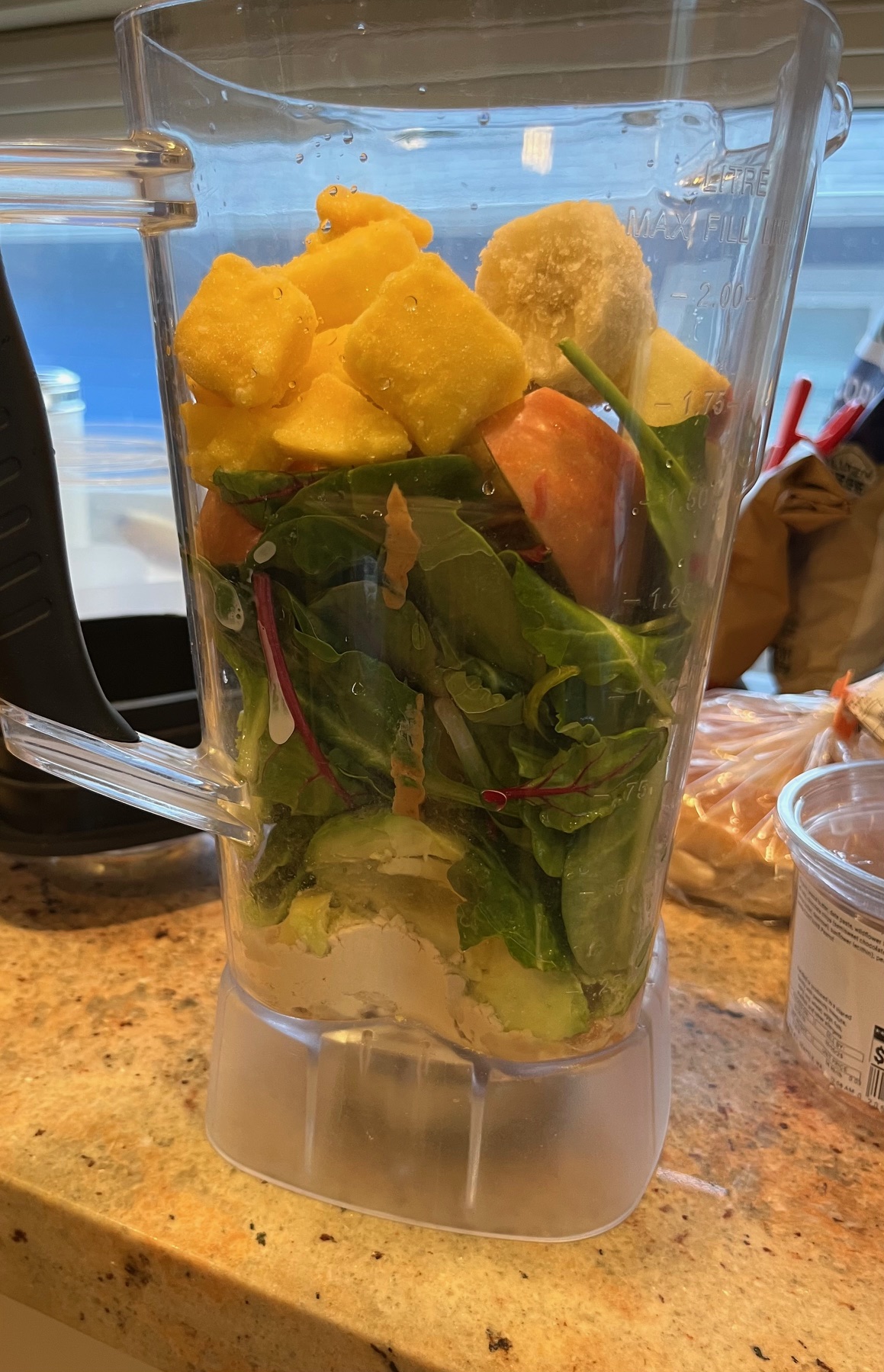
Smoothies continue to be the cornerstone of my daily diet — here’s what went into my smoothie yesterday: generous amount of baby greens (from Trader Joes), frozen banana, frozen mango, apple, avocado, tree nuts (I’ve been alternating between walnuts, cashews, brazil nuts), peanut butter, and pea protein powder. I start off the day with these, and then continue to consume it periodically throughout the day.

Expanding the diet

My cousin Kelly will be starting chemo soon, and we’re meeting up this evening so I can bestow upon her the icing kit that I used with many of my own chemo infusions, last year. We discussed meeting up for dinner, and I realized I had a conundrum: is there a local restaurant I can actually eat at, given my current restrictive diet? My go-to is always Asian food (Thai, Japanese), but I can’t eat vegetables, or peanuts, or virtually anything else that is healthy …

After puzzling over this quite a bit, exploring (and then striking out) many options, I sent a message to my care team at Fred Hutch, asking if they had any advice on this. I was happy to hear that they are ok with me beginning to expand my diet, at this point. They explained:


First, you can now advance your diet to include more fiber slowly as tolerated over the course of a couple weeks. The goal here is to introduce fiber one food at a time, chewing well.

Second, you can think about the shape/size of the food to assess the blockage risk. If it is a large chunk, it should be well cooked and/or well chewed.

Third, focusing on soluble fiber first is best as soluble fiber dissolves in water and doesn’t cause bulk, but you can start introducing all kinds of fiber one at a time.

Cool! I am happy about this. Still, however, I wasn’t sure about a restaurant. I was considering Indian food, maybe somewhere where I can get dal or something like that, but it seems like my initial experiment with new dietary options should be at home. Kelly and I have solved this issue by settling on meeting up a dessert place. That’s easier for me — it’s strange but true: less healthy, more processed foods = easier to do with an ileostomy.

But hey, I am very, very ready to move back towards a healthy diet. I mean look what I was doing, back on the morning of my first chemo infusion last summer — an insanely healthy smoothie with chard, kale, various berries .. gotta get back on that train, as this is a key part of the lifestyle to keep my cancer-free, moving forward. So my first venture into healthier eating involves a lentil soup, that I made last night. It includes:

Important to note, after cooking up this soup, I thoroughly pureed it in the blender, to reduce risk of any issues from the lentils. Had this for lunch today (combined with some white rice), and it’s tasty!

I’m realizing a blender is like your best friend, if you’re looking to eat healthy with an ileostomy. Next, I’m planning on starting to incorporate some greens (baby kale) into my smoothies and see how that goes.

ostomate life

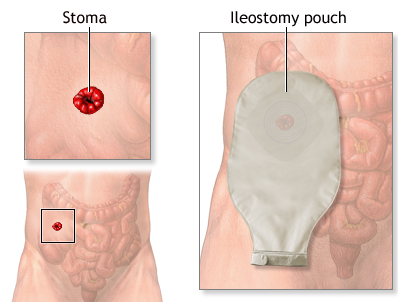
I am currently an ostomate: someone who has an ostomy. My particular type of ostomy is an ileostomy: in the surgery that occurred exactly one month ago today, part of my small intestine, aka ileum, was brought outside (near my belly button), forming an opening called a stoma. Since most of my rectum had to be removed, to rid me of cancer, I now rely on the stoma to excrete my solid waste (which actually isn’t totally solid yet, when it’s in the small intestine). So, I need to always have an ostomy pouch to collect all the “output,” as it’s referred to. I’m going to refrain from posting photos of my stoma and pouch here — I still have several residual scars from the surgery and it just doesn’t look pretty. Instead, here are some generic images.

The stoma is a trip. I’ll always remember the first time I saw it, while I was in the hospital, and a stoma nurse assisted with my first “bag change” (every 3 days, the ileostomy pouch is removed, discarded, and replaced with a new one). It’s like this little pink alien being down there, moving around in its mysterious dance of peristalsis.

Emptying the bag isn’t too bad; you just definitely don’t want it to get too full, or the adhesive seal will start to come undone, which then leads to a messy situation. That happened to me just one time, early on, in the hospital, and I learned my lesson from that. Also, I’m finding you need to embrace loose, high-waisted pants with an ostomy bag. I’m still actually figuring out the clothes thing — I just ordered some special ostomy underwear from Ostomysecrets® (yeah … I know). I’m curious to see if that helps make things more comfortable.

The bag change, which occurs every three days, is a fairly complex procedure. I found early on that you need to do it first thing in the morning, when nothing is coming out of the stoma. You do NOT want any output coming out of the stoma, as you’re doing the bag change. The cute little stoma dance turns into a nightmarish volcanic spectacle … enough said. After removing the old bag, you need to carefully clean all the skin around the stoma. An important step is thoroughly removing the adhesive residue — you do this with a special adhesive remover product.

There are, by the way, all manner of products for ostomy patients. I’ve gotten multiple calls from a popular ostomy product manufacturer; they sent me a gift box of samples and everything. Makes sense — if someone is an ostomate for life, there’s quite a compelling customer lifetime value to capture. Now, the plan is that for me particularly, there isn’t an entire lifetime of revenue that ostomy manufacturers will extract from me, but just a mere three-four months. At that time, the ostomy is supposed to be reversed (scheduling and details still tbd).

Few more notes about the bag change process — after you thoroughly clean the skin, you may need to apply ostomy powder (like diaper powder) on the skin if it’s irritated at all. And then a special product on top of that. And then, you measure the stoma, and you carefully cut out a ring in the adhesive of the new pouch — it needs to be just the right size. This requires special curved precision scissors. And then, you fit the new pouch onto that. There is this additional “caulking” material you can apply, to really get it to adhere .. I generally use that, as well. The whole process takes me around 30 – 40 minutes, including prep.

The real challenge for me is the diet; I need to follow a very restrictive low-fiber diet. It’s unfortunately not a very healthy diet. No fresh vegetables are allowed, at all. Very few fresh fruits are allowed, with the exception of bananas. Anything with seeds (e.g. berries) or peels (tomatoes) are a definite no-no. So I end up eating almost the same thing every day: bagels with creamy peanut butter, bananas, non-dairy yogurt (vanilla only), oatmeal, avocados. It’s this sad irony that I am not able to eat most of the highly-touted cancer-fighting foods right now, like blueberries, walnuts, etc. The dietary restrictions are my least favorite part of the ileostomy experience, but I get the reasoning behind them: you need to avoid anything that might cause a stoma blockage.

Alright, well maybe you’ve learned a thing or two about ileostomies from this post! Feel free to ask me questions if you’re curious about any of this stuff.

Clean margins

Yesterday I met with various members of my care team at Fred Hutch, where I learned a key piece of good news: pathology results from my surgery have been analyzed, concluding that the margins are clean.

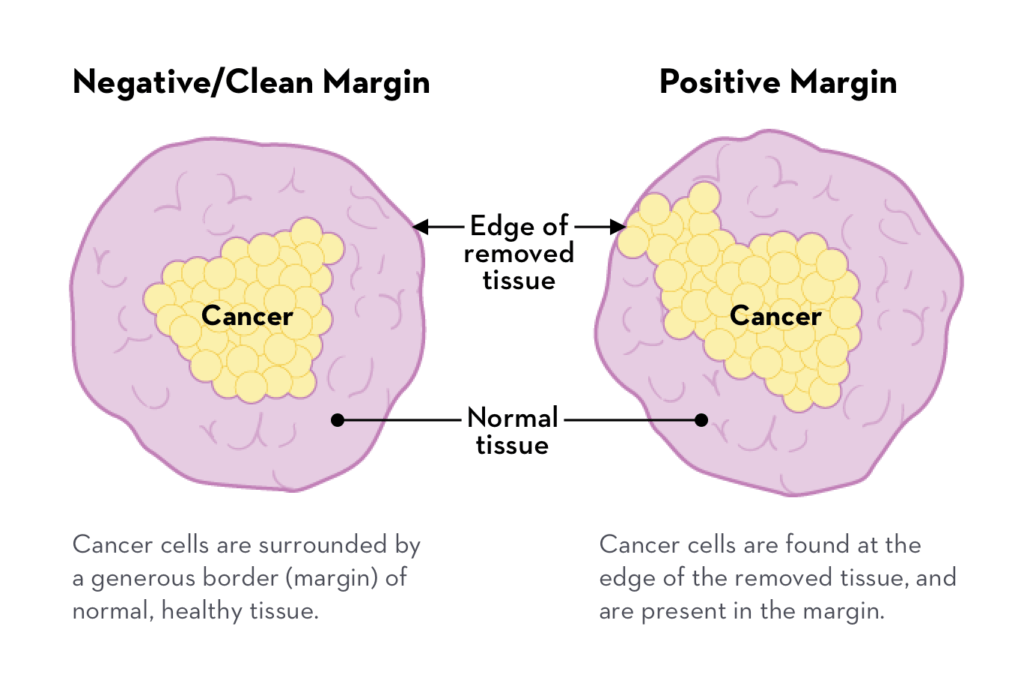
What does this mean? I’ll do my best to explain it, here, as I had no previous familiarity with this terminology. Basically, with a surgery that removes a cancerous tumor, the surgeon cuts out extra tissue that surrounds the tumor. The goal here is to ensure that there are clean margins fully surrounding the excised tumor. I found an image online that breaks this down. A positive (“unclean”) margin is bad news, which apparently can necessitate a followup surgery to cut more out.

Clean margins = surgery success: the cancerous tissue is considered fully removed. But, I asked yesterday, is this equivalent to NED (No Evidence of Disease)? No, they told me. They wouldn’t be able to declare me NED until my next set of scans (not sure, yet, when these will be).

I’m eager to confirm that NED date, honestly because in the colorectal cancer survivor community, everybody celebrates their NED anniversary. Certainly, in years hence, I want to be able to proclaim my NED anniversary as well!

But for the time being, I’ll gladly celebrate all of the information I do have. My last set of scans occurred just a few months ago, in late November. And according to those scans, there wasn’t cancer anywhere in my body, except for the tumor itself — which is now gone. At this time, there is no need for me to do any additional treatment. The big remaining step for me is the ileostomy reversal surgery, which is yet to be scheduled, but may potentially occur sometime in April. I learned yesterday that two diagnostic steps must occur before that surgery: a barium enema (yikes, doesn’t sound fun), and a sigmoidoscopy. They are working on getting those scheduled.

Was my surgery recovery process difficult? Yes, it had its challenges — especially in the first 2 1/2 weeks of recovery time.

Was chemo hard? Definitely.

Did I complain a lot throughout these treatment phases? Yep, just browse through past entries in this blog…

And was it all worth it? Absolutely. This is a no-brainer! These have all been critical steps in ensuring my lifespan is extended. I feel grateful to have had the opportunity to fully focus on the “three act play” of cancer treatment over the past nine months (Radiation, Chemo, Surgery), and am looking forward to shifting my focus to living a normal life, later this year.

Plenty more to share in this blog, though. I haven’t said much yet about life with an ostomy, and associated diet. Also, I’m honored to now be part of the planning committee for the Seattle Walk to end Colon Cancer — I’ll certainly have more to say on that topic in future posts. 🙂

Ileostomy School is in Session


It was a busy day of learning today in Jonathan’s hospital room.

He had visits from various medical professionals, who are all focused on sharing key information that he will need once discharged from the hospital.

The first visit was from a physical therapist (who also happens to live nearby in Jonathan’s neighborhood). She transitioned Jonathan from a walker to a cane and showed him how to walk up and down stairs properly. Jonathan was very happy to get out of his hospital bed and walk around the hospital wing.

At the end of her visit, she officially graduated Jonathan from physical therapy and he’s now considered independent. He’s now walking circles around the floor on his own. Yay!

The second visit was from an ostomy nurse named Sunny. I stepped out of the room for that particular visit, but Jonathan tells me that Sunny was super informative and a great teacher. Jonathan learned a lot about caring for his ileostomy and is feeling more confident about managing it on his own.

The third visit was from a dietician named Lisa. Jonathan needs to follow a strict low fiber diet for six weeks following his discharge until the swelling from his ileostomy goes down. He also learned about how foods impact the output in his ostemy bag, and how and when to make dietary changes.

In summary: soft foods = good! Popcorn and seeds = bad!

He will also get a visit at some point today from the pharmacy team who will show him how to administer shots (he’ll need to do this for 4 weeks). Jonathan is already a pro at this, thanks to the Nivestym shots that he had to administer during chemo.

The doctor thinks Jonathan might be able to go home as early as tomorrow, but we’ll find out in the morning.

The one negative about today is that Jonathan received a new roommate in the middle of the night. The new roommate is very nice, but has a lot of medical professionals and family members coming to visit him, so it hasn’t been very relaxing and it’s impacted Jonathan’s ability to sleep.

The medical staff is trying to get Jonathan transferred to a private room, so fingers crossed!

All in all a good day. Jonathan is making great progress and we are eager to get him settled in at home.

A more positive take

I met with the surgeon (and team) this past Monday. The day started off bright and early with a sigmoidoscopy, and I feel like that gave a more positive perspective on what chemo + radiation has accomplished inside my body. I should start by saying that being wide awake for a sigmoidoscopy is …. an unsettling experience (just google it). But after the camera went in, I was surprised to see … no tumor. Way, way different from how it looked in the past sigmoidoscopy, back in May (before I started treatment). That initial procedure described “a fungating and polypoid partially obstructing mass.” By contrast, in this week’s sigmoidoscopy, that scary-looking mass was gone, replaced by white scar tissue. This was honestly encouraging for me. I get that there is still some tumor remaining (embedded in the layers of tissue that surround the rectum), hence the “moderate response” terminology in the recent MRI summary. Next month’s surgery will take care of that. It was just encouraging to see that visual contrast in the sigmoidoscopy results.

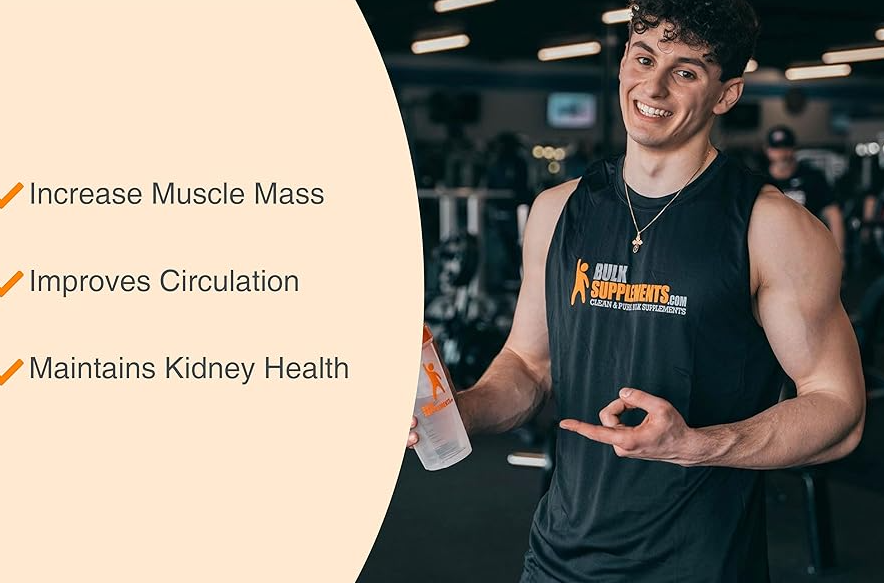
All in all, very positive meeting that day with the surgeon and the nurses who work with him. The nurses provided me with a binder of information (like a 100 pages) on preparing for the surgery, and life after surgery, etc. A week before the surgery, they advised me to start adding Immunonutrition shakes to my daily diet. My dairy allergy doesn’t allow me to take the Ensure Surgery product they recommended, but they’ve worked with me to determine how to get what I need via alternate means: additional protein, fish oil supplements, arginine powder. Just ordered the arginine powder on amazon, it’s apparently a product favored by body-builder types. This photo was in the amazon listing for the arginine powder I ordered, so I fully expect it to make my arms look like this:

The next nurse I met with is an ostomy nurse; a very helpful and informative session about preparing for life with a temporary ileostomy. This surprised me: she had me lift up my shirt, she pulled out a marker and made a couple marks on my belly where they’ll do the ostomy incision. She put stickers over those — the plan is to keep those marks on me until 1/3 — kind of strange. And she gave me an Ostomy Home Skills Set© (yes, it has the copyright symbol) — which includes another marker that I can use to re-do the marks on my belly.

The surgery itself will have me in the hospital 3-5 days. Jan 2 (the day before the surgery) will basically be the same process as prep for a colonoscopy, along with a few other minor elements. I’ll be taking the entire month of January off (FMLA + short-term disability) to allow sufficient time for recovery. I’ve been in the process of sharing this information at work.

For now, I’m continuing to enjoy the month of December — post-chemo, pre-surgery — a nice respite.