Officially NED

I confirmed today with my care team that yes, it’s official, I am NED as of May 9! This means:

  • I am now in what they described as “surveillance mode” — they’ll be checking on me periodically. My oncologist said ordinarily I would now do scans every 6 months (with bloodwork every 3-4 months) but she needs to check the stipulations of the clinical trial I participated in last year. I am pretty sure the scans are more frequent with that trial.
  • The port will come out — I’ll no longer be a cyborg!
  • The active topic now is focusing on my continued recovery from the recent reversal surgery. It’s all about what comes in, and how frequently it goes out. I did get the green light today to expand my diet. Psyllium husk powder every day is working well for me, and I’ll continue with that.
  • My only concern from today’s visit is that my bloodwork from this morning shows that my white blood cell counts have dropped a lot — lower than they ever were during chemo last year (and they were quite low then). They didn’t seem too concerned, suggesting this may be a delayed reaction to radiation, but that doesn’t seem right to me. Radiation for me was a year ago (happened last May-June). I asked them to check into this further.

Life after reversal surgery

Fortunately, things have been much easier with my reversal surgery than my prior surgery, back in January. With my reversal, I was discharged from the hospital two days after the surgery took place. I’m back at work, as of yesterday. My energy levels are good; there were just a few days of fatigue. And my pain at the surgical site has improved; I was able to manage it with just Tylenol after I was discharged, and I haven’t had any Tylenol since yesterday morning.

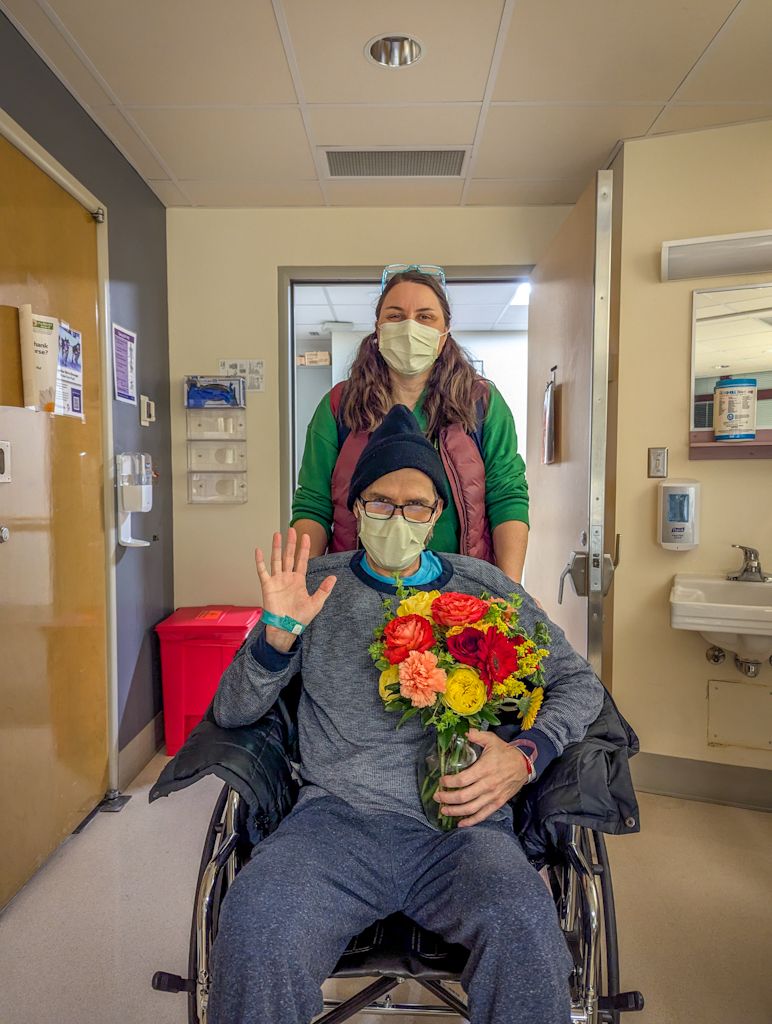
An hour or so before the reversal surgery took place, back on Apr 18, a resident physician (who worked with my surgeon on the procedure), spoke with me briefly about what to expect with the surgery. “Did you give it a name?” she asked. After a few moments of confusion, I realized she was talking about my stoma. I told her no, I never named it (although I did observe this to be a thing that other folks do, noted in the ostomy subreddit and other places). She seemed to be ready to comfort me with any grief I had about the loss of the stoma through reversal surgery. Nope … I felt no sadness about the end of that phase. Yes, it was a pretty enlightening experience, having the ileostomy, but I am certainly ok to move on.

On the morning of my discharge from the hospital, that same resident came by and helped change my dressing over the wound site. The wound was “packed” (gauze was coiled inside the hole in my stomach) and I watched with somewhat horrified fascination as she pulled out that blood-soaked gauze, and applied new dressing. I’ve been doing this same routine on my own, every day since, along with a thorough cleaning of the area via a shower. The hole is already closing up — pretty fascinating to track its progress every day. When I first got out of the hospital, it looked like this surreal second belly button — not too far away from my actual belly button — and a bit wider. Just to clarify, this hole did not go all the way into my innards; the resident explained that it stopped at the layer of my abdominal fascia.

Other than those daily cleanings and dressing changes, the main challenge post-reversal has really been adjusting to having a functioning colon again — with a rectum that is now considerably smaller. I have read several stories of folks dealing with LARS after their reversal and I was prepared for something similar, myself. But things seem to be largely ok with me in the bathroom area, after an initial period of constipation (which I was able to address via Miralax). Bowel movements are certainly more frequent, with associated urgency, but I’m already seeing improvement with this as well, day after day.

I continue to derive tons of helpful information from the Colontown family of online forums; yes they have one specifically dedicated to all things reversal (“Reversal Roundabout.”) From there, I learned that a first order of business for many folks after their reversal is to restore their gut’s bacteria through probiotics. The challenge is that with a reversal surgery –as with the LAR surgery before it — you get stuck on a restrictive low-fiber diet, which excludes most of the effective dietary sources of probiotics. So what a lot of folks do, I learned, is drink kombucha, at least up until their dietary guidelines loosen up again. I had never actually tried kombucha before, but decided to give it a shot, starting around a week ago, and I quickly realized I love it! Tasty and refreshing!

A week from now, I have CT scans at Fred Hutch; assuming all is clear from those, I’ll finally be able to start saying I’m NED. Of course, you never know what the scans may reveal. I’ve been tracking a variety of stories in Colontown, and of course not everything is positive. Someone with a Stage 3 diagnosis who started chemo on the exact same day I did, last year, just got news that her cancer is metastasizing and she’s now stage 4. I’ve also read recent posts of stage 4 patients passing away. These are notably poignant when it’s the patient themselves sharing the news of their upcoming demise. That said, I do not have “scanxiety;” instead I’m aware of the spectrum of possibilities that may come out of any CT scan, and will take things one step at a time.

Clean margins

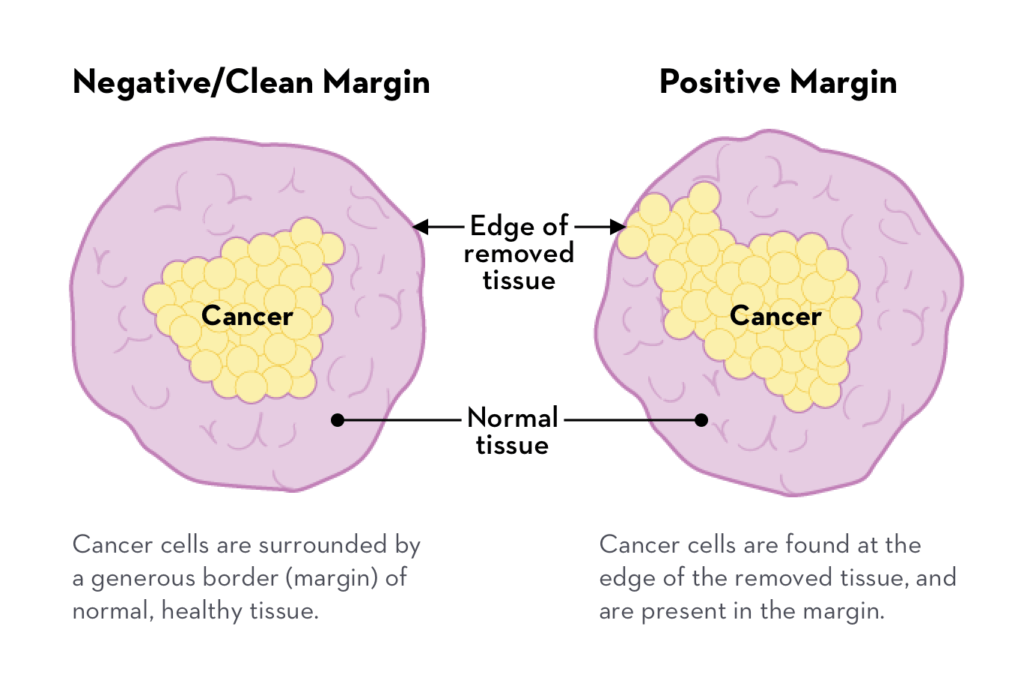
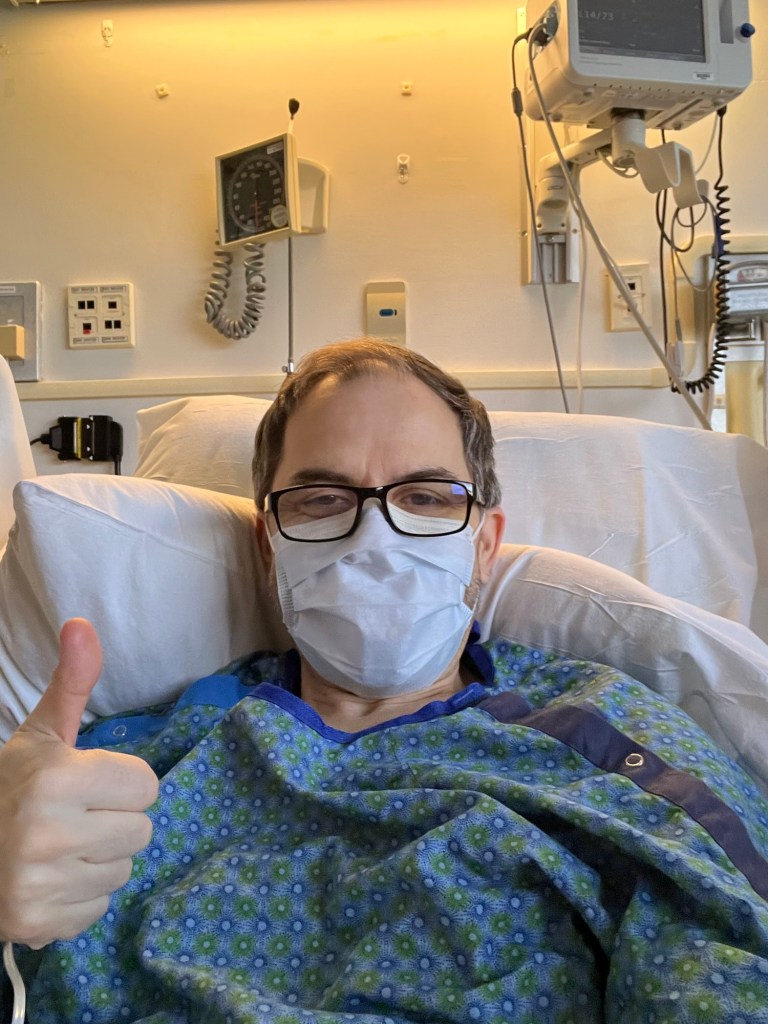
Yesterday I met with various members of my care team at Fred Hutch, where I learned a key piece of good news: pathology results from my surgery have been analyzed, concluding that the margins are clean.

What does this mean? I’ll do my best to explain it, here, as I had no previous familiarity with this terminology. Basically, with a surgery that removes a cancerous tumor, the surgeon cuts out extra tissue that surrounds the tumor. The goal here is to ensure that there are clean margins fully surrounding the excised tumor. I found an image online that breaks this down. A positive (“unclean”) margin is bad news, which apparently can necessitate a followup surgery to cut more out.

Clean margins = surgery success: the cancerous tissue is considered fully removed. But, I asked yesterday, is this equivalent to NED (No Evidence of Disease)? No, they told me. They wouldn’t be able to declare me NED until my next set of scans (not sure, yet, when these will be).

I’m eager to confirm that NED date, honestly because in the colorectal cancer survivor community, everybody celebrates their NED anniversary. Certainly, in years hence, I want to be able to proclaim my NED anniversary as well!

But for the time being, I’ll gladly celebrate all of the information I do have. My last set of scans occurred just a few months ago, in late November. And according to those scans, there wasn’t cancer anywhere in my body, except for the tumor itself — which is now gone. At this time, there is no need for me to do any additional treatment. The big remaining step for me is the ileostomy reversal surgery, which is yet to be scheduled, but may potentially occur sometime in April. I learned yesterday that two diagnostic steps must occur before that surgery: a barium enema (yikes, doesn’t sound fun), and a sigmoidoscopy. They are working on getting those scheduled.

Was my surgery recovery process difficult? Yes, it had its challenges — especially in the first 2 1/2 weeks of recovery time.

Was chemo hard? Definitely.

Did I complain a lot throughout these treatment phases? Yep, just browse through past entries in this blog…

And was it all worth it? Absolutely. This is a no-brainer! These have all been critical steps in ensuring my lifespan is extended. I feel grateful to have had the opportunity to fully focus on the “three act play” of cancer treatment over the past nine months (Radiation, Chemo, Surgery), and am looking forward to shifting my focus to living a normal life, later this year.

Plenty more to share in this blog, though. I haven’t said much yet about life with an ostomy, and associated diet. Also, I’m honored to now be part of the planning committee for the Seattle Walk to end Colon Cancer — I’ll certainly have more to say on that topic in future posts. πŸ™‚

Easing back in … gradually

My lesson over the last few days: post-surgery fatigue can be pretty intense! And for me, it’s notably different from the fatigue that I had with chemo.

Everyone’s experience with cancer treatment varies, but for me, chemo fatigue was mental: my brain was mush and I don’t generally remember those periods. Post-surgery fatigue, by contrast, is totally physical. My mind is ready to go, but my body says: not so fast.

Yesterday, for example, was a very fatigue-y day, with four naps. These were not β€œfun naps” involving reading or something. No, these were full-on sleep. My big task for yesterday (interrupted by a nap, and a meal, and a period of staring out the window) was changing out all the trash bags in the house, and bringing the trash / compost / recycling outside.

The day before, I possibly pushed myself too much β€” I took our dog out for a walk around the neighborhood. I was completely exhausted at the end of that, and maybe (?) still recovering the next day. Or, maybe recovery from surgery isn’t always a neatly predictable thing.

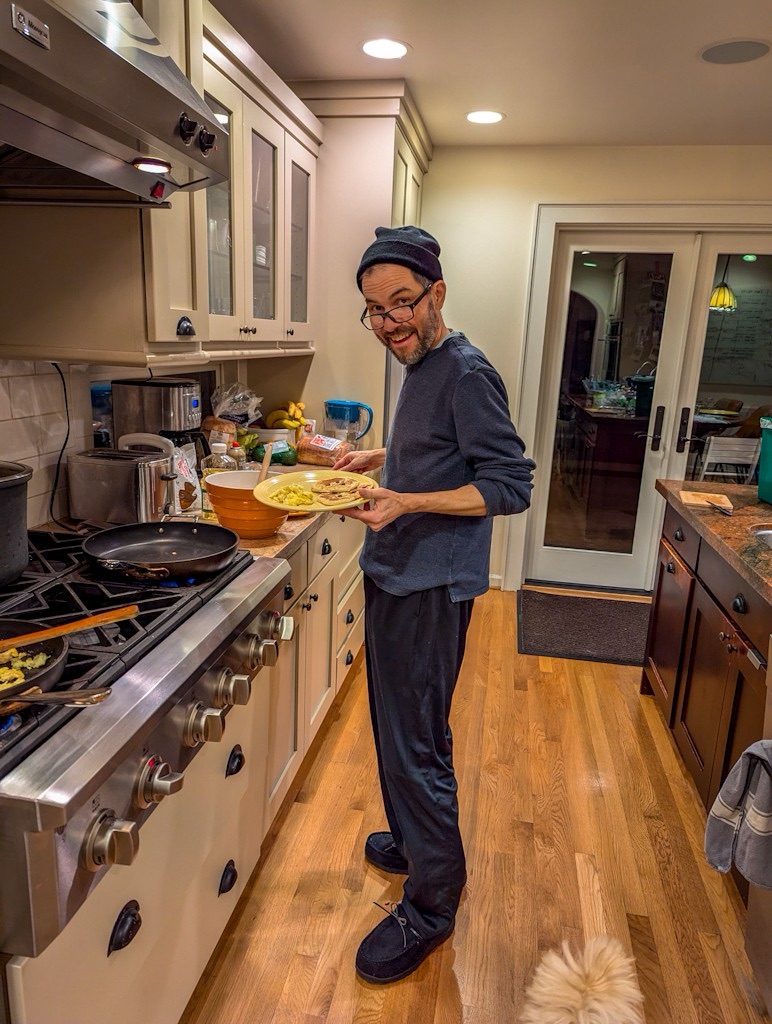
Last week, I actually made up a dinner of pancakes and eggs (trust me, things were a lot harder last week … so this was an accomplishment):

I hit a wall, big time, at the end of that β€” actually I remember I started to fade before I had made all the pancakes; my sister Katy told me hey .. why don’t you take a break there .. but no! I stubbornly insisted on finishing up all the batter, and then collapsed into the recliner, totally spent.

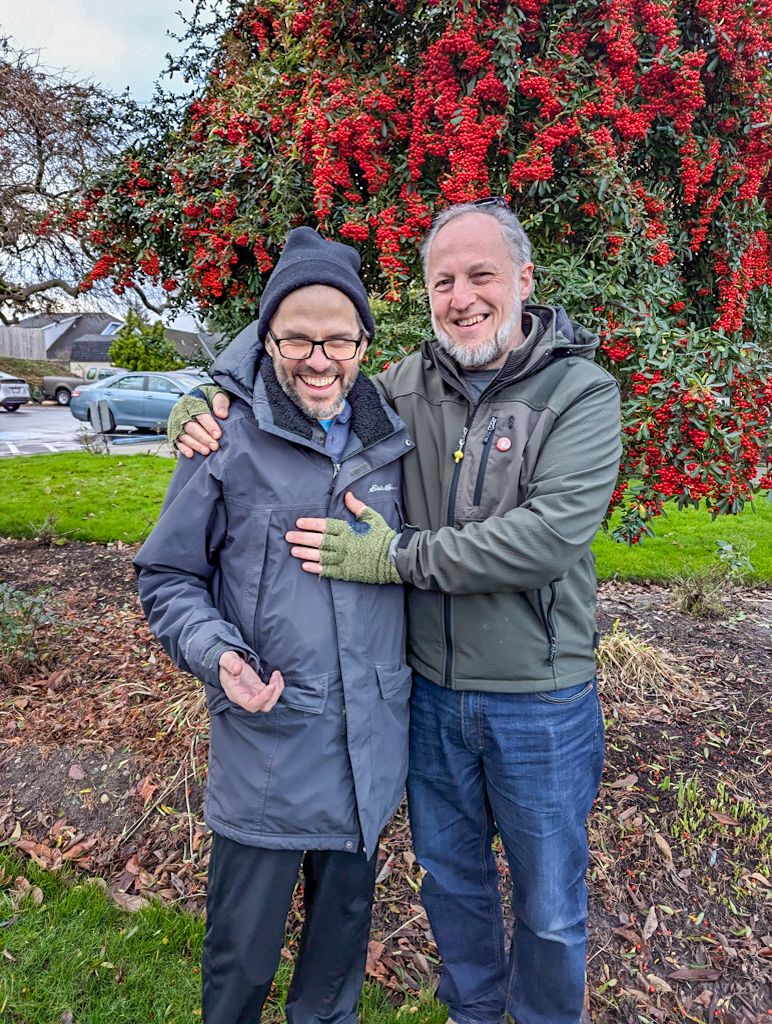
Today was a pretty good day. I am listening closely to my body. I had enough energy to go out for a 15-minute walk –

That was good for the day, and the rest of my time I’ve spent active inside on various tasks. And one big afternoon nap.

Nick rant

Hey everyone, I want to profusely thank my sis Katy for helping with blog posts over these past few weeks. She also helped in countless ways around our house, and with our kiddo, as I have recovered from surgery. Katy headed back home to Eugene yesterday, and I’ll resume writing the posts in this blog.

As mentioned previously, my bladder was nicked during the surgery, resulting in me wearing a catheter for two weeks. Those two weeks are indeed over (thank goodness) — the catheter came out yesterday. I am now basically re-learning how to pee, which is a painful, trial-and-error process. I was hoping to write a celebratory post today about being catheter-free, but it seems I’m not quite out of the woods yet.

Candidly, I’ve struggled with a lot of anger about this whole bladder “nick” and all the misery it’s caused me. Let me just vent a bit. Sometimes we cancer patients just need to vent — here we go:

  • I had no idea what the #$%& I was doing: As an ostomy patient, I received very detailed (honestly fantastic) instructions and guidance from wonderful ostomy nurses, really focused on day-to-day management of emptying and changing ostomy bags. But there wasn’t anything comparable on life with a catheter, except a video that said I need to clean the drainage bag with bleach every day.
  • The bleach cleanings: So I think these instructions were maybe(?) excessive, but I was terrified of getting a UTI, so I diligently followed them: any time I changed the catheter drainage bag (twice a day: once in the evening, and once in the morning), I thoroughly cleaned the drainage bag with soap and water, and then let it soak in a diluted bleach solution. This involved using a large syringe to pump the drainage bag full of the bleach solution.
  • Very limited mobility with the “night bag”: I had a large drainage bag for sleeping, with a hook — if I needed to move around, I carried it by the hook (or tried a few different methods to tote it). The problem was that this bag had large, rather inflexible tubing and I had to move very slowly, very gingerly lest I bump the tubing in just the wrong way: voila, a painful tugging feeling…
  • Mobility challenges with the “leg bag”: For daytime use, I had a smaller drainage bag that attached to my leg via (uncomfortable) velcro straps. Admittedly, it was easier to walk around with this — kind of. The hospital sent me home with a fabric / velcro strap to secure this to my leg, but that quickly got stretched out, which meant it kept slipping down my leg. Which resulted in that painful tugging feeling..
  • Lots of time experimenting with hacks: As I was flying blind, I ended up googling alternative catheter securement devices, and bought a few options on amazon — these were adhesive, so I spent a lot of time shaving my legs, experimenting with the right position. This definitely included some failed experiments (I do not recommend the “swivel”-style device) … that resulted in hours of considerably painful tugging.
  • Very little sleep: extended catheter use can often result in bladder spasms; I was prescribed oxybutynin to deal with these. The most common side effect of oxybutynin is dry mouth, and it’s a humdinger, in my experience — I had an overwhelming urge to continuously drink water. This made sleep well-nigh impossible. There are tips online for dealing with the dry mouth, but these are all daytime stuff (chew gum, suck on ice) — you can’t do them while you’re sleeping. So I didn’t sleep much.

Given all the above, I am thrilled that the damn catheter is out of me, and I do hope the current adjustment period back to normal bladder function doesn’t last too long. I think my situation (catheter + ostomy) must be a fairly rare thing with LAR surgery patients; otherwise I think I would have had more instructions on how to get through it.

Fingers crossed, next week goes more smoothly…

Walking is Good Medicine

After a week filled with ups and downs following his discharge from the hospital, Jonathan is beginning to adjust to life at home.

Jonathan and James

Jonathan’s doctor recommended that he remain active by moving around and walking. Jonathan really enjoys walking and so has started going on long walks. He’s found that walking is a great way to ease the tightness in his left calf.

This weekend he walked a mile both on Saturday and on Sunday. Thankfully the weather cooperated and he had lovely weather both days.

This afternoon, James and I joined Jonathan on his afternoon constitutional. Hooray for walking buddies!

While he still continues to struggle with catheter management, Jonathan’s bladder is feeling much better now that he’s taking Oxybutynin. So that’s good news as well.

Let’s hope things continue to improve this week as well!

Jonathan, Katy & James

Post Surgery Recovery Update

Hello Jonathan’s Fan Club!

It’s been 5 days since Jonathan was discharged from the hospital so I figured it was time for an update.

Jonathan has enjoyed being back at home with his family and in familiar surroundings. It’s a relief to wear regular clothes again and to feel some measure of normalcy return.

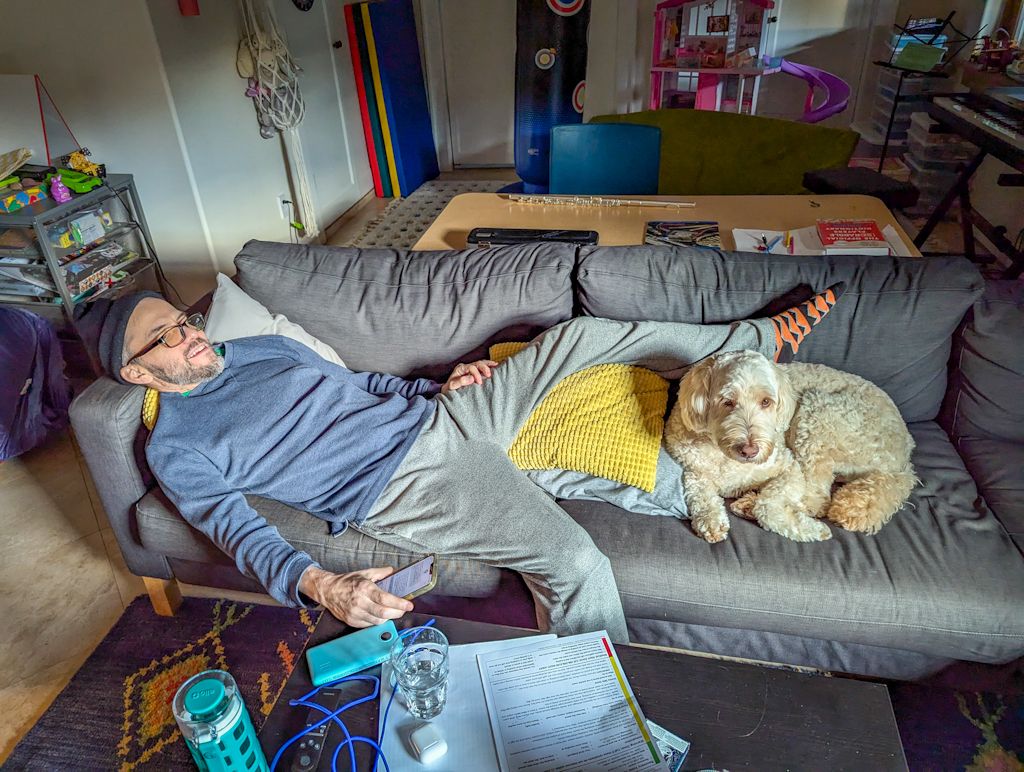
Jonathan relaxing at home and elevating his left ankle, while dog Sunny snuggles in close

That being said, being back at home has also been a challenging transition filled with ups and downs.

First, the good news: his ileostomy looks great and it is healing well. Jonathan received excellent training on how to care for the ostomy from the nursing staff and he feels confident he can manage it on his own. He had a follow-up appointment yesterday with the ostomy nurse and so far so good. The ostomy needs to be completely changed every 3 days and he’ll be doing the next one on his own.

Thankfully that part of the recovery is going well because he’s dealing with some challenges that he didn’t anticipate prior to the surgery.

Since Jonathan’s bladder was nicked during the procedure, he has to wear a catheter at home for two weeks. That has been a challenge, especially because he didn’t receive adequate education in the hospital on how to deal with a catheter at home. Jonathan has been slowly getting the hang of it, but it’s been a frustrating process and a lot more work than we anticipated.

Jonathan also continues to experience pain in his left calf occasionally, along with some swelling in his ankle which we suspect might be edema. A PA checked out the leg yesterday morning, who recommended another ultrasound to rule out Deep Vein Thrombosis (DVT). He had the ultrasound yesterday afternoon and there is no sign of a blood clot so that’s good news.

We are somewhat mystified as to why the pain has returned because his calf felt pretty much back to normal when he was discharged. So we are keeping an eye on it and monitoring the situation. He’s walking a lot which is helping to relieve the pain.

And now onto the third challenge: Jonathan was accidentally prescribed medication with an enteric coating. Ileostomy patients are supposed to avoid this kind of medicine because it can pass through without being absorbed into the system – and even block the stoma.

Jonathan discovered the error when he noticed that no output was flowing into his stoma bag and then found an entire pill in there. The medicine, Oxybutynin, was prescribed by the urology staff to help reduce pain and bladder spasms due to the emergency bladder surgery.

He stopped taking the medicine right away and got the prescription changed to a quick dissolve formula. However, we missed the notification that the prescription was in at the pharmacy and honestly lost track of it during yesterday’s medical appointments on his calf and ostomy.

Unfortunately, Jonathan had a lot of bladder discomfort last night – which reminded us to follow up on getting the new prescription. We picked it up from the pharmacy first thing this morning, and hopefully he’ll start feeling relief soon.

Jonathan has a couple of follow-up appointments next week, including one with the urology staff. Hopefully they’ll give him the all-clear on his bladder and remove the catheter so it’s one less hassle to deal with.

Big thanks to both Sarabeth and Jen who have been a huge help this week, along with family and friends who continue to provide love and support.

Xoxo,
Katy

Welcome Home, Jonathan!

I’m happy to report that Jonathan was discharged from the hospital late this afternoon. He is now home safe and sound and is relaxing with his family.

Earlier today, Jonathan had a second session with the ileostomy nurse Sunny. After that session, Jonathan felt comfortable that he could manage and change the ileostomy on his own.

That hurdle cleared, Jonathan was given the green light by Dr Liu to go home. The nurses removed his JP drain, showed him how to manage the catheter, and finalized the discharge process.

Welcome home, Jonathan!

Ileostomy School is in Session


It was a busy day of learning today in Jonathan’s hospital room.

He had visits from various medical professionals, who are all focused on sharing key information that he will need once discharged from the hospital.

The first visit was from a physical therapist (who also happens to live nearby in Jonathan’s neighborhood). She transitioned Jonathan from a walker to a cane and showed him how to walk up and down stairs properly. Jonathan was very happy to get out of his hospital bed and walk around the hospital wing.

At the end of her visit, she officially graduated Jonathan from physical therapy and he’s now considered independent. He’s now walking circles around the floor on his own. Yay!

The second visit was from an ostomy nurse named Sunny. I stepped out of the room for that particular visit, but Jonathan tells me that Sunny was super informative and a great teacher. Jonathan learned a lot about caring for his ileostomy and is feeling more confident about managing it on his own.

The third visit was from a dietician named Lisa. Jonathan needs to follow a strict low fiber diet for six weeks following his discharge until the swelling from his ileostomy goes down. He also learned about how foods impact the output in his ostemy bag, and how and when to make dietary changes.

In summary: soft foods = good! Popcorn and seeds = bad!

He will also get a visit at some point today from the pharmacy team who will show him how to administer shots (he’ll need to do this for 4 weeks). Jonathan is already a pro at this, thanks to the Nivestym shots that he had to administer during chemo.

The doctor thinks Jonathan might be able to go home as early as tomorrow, but we’ll find out in the morning.

The one negative about today is that Jonathan received a new roommate in the middle of the night. The new roommate is very nice, but has a lot of medical professionals and family members coming to visit him, so it hasn’t been very relaxing and it’s impacted Jonathan’s ability to sleep.

The medical staff is trying to get Jonathan transferred to a private room, so fingers crossed!

All in all a good day. Jonathan is making great progress and we are eager to get him settled in at home.